Thursday, April 21, 2011

Book Review: Move Into Life

Many people ask me about the differences between Hellerwork Structural Integration and The Feldenkrais Method. My short answer is that structural integration approaches a change of movement patterns by addressing the body’s connective tissue, which then affects the rest of the body including the nervous system. The Feldenkrais approach seeks to reeducate the brain and nervous system for improved movement patterns that affect the rest of the body. Several new books use the Feldenkrais approach and one of the best is Move Into Life: The Nine Essentials for Lifelong Vitality written by Anat Baniel.


It’s easy to see why people find it difficult to differentiate the modalities without having experienced them. Baniel’s nine essentials are oh-so-compatible with structural integration and especially with undulation. Here’s a brief summary of the essentials for vitality, but I encourage you to explore more for yourself.


  1. Attention – Awareness is the first step in any change (please see my previous blog post) and Baniel explains why. Awareness increases brain activity, which makes new patterns possible.
  2. The Learning Switch – Fight or flight and freezing caused by stress have turned off the learning switch for many of us. Regaining beginner’s mind can turn it back on.

  3. Subtlety – We’ve been conditioned to force being the path to accomplishment, but it blocks the intelligence of intuition. Subtlety is needed to find all movement between the extremes.
  4. Variation – Up to this point in the book, I’ve been nodding my head in agreement, but here is where I start to say out loud, “Yes, YES.” Variation in movement increases brain synapses, decreases rigidity and allows for dramatic transformation.
  5. Slow – When we move fast, there is no room for new experiences, railroading us into unproductive patterns. Moving slowly is counterintuitive, but better for harder tasks.
  6. Enthusiasm – Although it seems as though enthusiasm is something that comes from without, Baniel asserts that it is a skill we develop from within. In Hellerwork, we call this inspiration and maintain that it is fundamental to wellness.
  7. Flexible Goals – We’re back to undulation here. Baniel suggests that we try three different ways to accomplish a goal. “Getting off course” is often just what we need to expand our capabilities.
  8. Imagination and Dreams – Brain patterns are equivalent when imagining and doing things in real life. Playfulness creates a more flexible brain. It’s strange that we use less imagination and have fewer dreams when we get older, when we need them the most.
  9. Awareness – This feels like an extension and deepening of the first essential, attention. After adding subtlety, variation, enthusiasm, flexibility and imagination, the reader is able to be more aware, bringing all nine essentials together.

    Baniel includes a couple of useful movement exercises in each chapter and dozens of examples that make the reading easy. If you get this book, please let me know how it affected you.

Friday, April 15, 2011

Change for the Better -- In 3 Steps

Change happens to us. Sometimes change happens through us. Occasionally, we stop in the midst of change and direct it for our own purposes. Many of my clients are frustrated with changes that are happening to them. While most people hope the cause of their affliction will stop, life doesn't always work that way. What does work is to follow a process for transformation. I recently learned that this process has a name, Maslow's Four Stages of Learning.

Everyone stands dozens of times a day with little or no awareness of their posture. When we do an assessment in a structural integration session, most people are surprised to find that their toes and knees don't face forward, their pelvis is not level and, most commonly, the hips are forward of the ankles so the low back sways to counterbalance. That is an opportunity to move from the first stage of learning, Unconscious Incompetence, to the second, Conscious Incompetence.

Being aware of the problem is the first step toward having control over change and leads naturally to the third step. Conscious Competence is the ability, with awareness and concentration, to put a new skill into place, such as lining up feet and knees, dropping the pelvis to level, and bringing the hips back and chest forward. People are pleased to gain tools that give them some control over their symptoms, such as standing or sitting in alignment, using the core to protect the low back, or adding fluid movements to counteract repetitive motions. But these new behaviors take time to develop and the body-mind reverts easily to the unconscious pattern that created the problem in the first place. A client told me of a conversation overhead in her physical therapist's office of another patient who was discussing his shoulder problem. He was frustrated when he frequently fell back into old movement patterns that exacerbated his shoulder injury. This is true for everyone in this stage.

After the elation of the first couple of sessions, most clients want to know, "When will my new posture become automatic?" It takes much practice in the Conscious Competence phase to get to the fourth, Unconscious Competence. Repetition is necessary and reminders are helpful, one reason why I give the little movement homework handouts at the end of most sessions. For myself, I also use sticky notes, like "Sit Bones" on the computer or "Balance" on the bathroom mirror.

Most powerful of all is to demonstrate and explain the new skill to someone else. I implore clients to teach their children how to sit in alignment, to help their kids and to strengthen their own kids and to strengthen their own competence. Eventually, one will notice that they are in alignment without any effort - a cause for celebration! Then it happens more often. The old patterns return sometimes and that's OK, because we have the tools to bring about change for the better.

Saturday, March 26, 2011

Article #200

Since I started this blog in July 2007, I have posted 199 articles. This is number 200. My goal has been to offer doable ideas for staying healthy with a focus on modern-day physical fitness. Doable means being able to incorporate them into your everyday life and beneficial for anyone regardless of the physical condition. The complex nature of the body and its connection to the mind and spirit makes this a limitless subject. I try to sort through the ideas and offer them in short, entertaining segments.

There are recurring themes in this blog, ideas that bear repeating, such as:

Stay within your personal abilities to avoid injury
The cultural “push your limits” belief often results in strained muscles and ineffective compensation patterns. I love Nike’s slogan “Just Do It.” But that doesn’t mean that you have to do a marathon or lift all the weights in the gym. Just do whatever you do regularly do and you’ll naturally progress.

Add variety to your routine
This is especially important if you spend most of your day in repetitive tasks, like driving or computing or bodywork. Of course, I believe undulation is a silver bullet, a way to easily undo the strain of stillness and overuse. A client suggested that I include an “Exercise of the Month,” which I’ve done since July 2009. From undulations to relaxations to core strengthening, each month offers a quick and easy way to add variety to your fitness.

Mind, body and spirit are connected
Your attitude toward your body makes a difference in how much pleasure or pain you experience. Playfulness and compassion are better companions than rigid obligations and punishment. Trudging through exercise or work, although sometimes necessary, creates patterns of tension that can be harmful in the long run. Joyful activities create ease and are just as effective at increasing strength.

I hope that the ideas I present will help you live more comfortably in your body. I invite you to offer suggestions for future articles or share techniques that have worked for you.

Thursday, March 17, 2011

Single Leg Stance - Exercise of the Month


Staying strong enough to stand on one leg sounds easy, but the hip stabilizers on most adults (who sit most of the day) are too weak to do this without compensation. The answer is to stand on one leg in alignment every day. Build it into your routine, like when brushing your teeth or waiting for the computer to start up.

Stand tall and transfer your weight from both feet to one, without shifting your hip more than an inch to that side. I recommend holding onto a chair, counter or wall to start. Watch for and eliminate any of the following compensations.

Do not let your hip sway far to the side. Keep your side and rear muscles engaged so your hip does not jut to the side. Also, do not lift or drop one side of the pelvis as shown below. Your core muscles are required to keep your pelvis level.


If you can maintain balance on one leg without lifting or shifting your pelvis, let go with your hand and maintain the single leg stance building up to a minute or more. If you can’t maintain the balance without holding on, gradually reduce the number of fingers that touch the base of support.

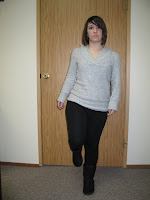
By the way, the beautiful model in the photos is Tori, my new assistant. She is enthusiastic about structural integration, very pleasant and capable, and, obviously, a good sport.

Wednesday, March 2, 2011

Weak Hips Lead to Back Pain

Many people – especially women – have an embarrassing secret. Most don’t know this about themselves until the situation is desperate, until the consequences are dire, until it is almost too late to correct the problem. The secret is this. Their hips are not strong enough to carry their body weight.

It seems like an overnight phenomenon: a sudden, unexplained occurrence of back pain. But the conditions have been building, unnoticed for years. After age 35, our muscles turn to fat at the rate of about 1% a year in a process called sarcopenia. As we get older, we also tend to add pounds. The muscles that stabilize the hips get weaker and weaker, the body adds unconscious compensations, until eventually the back muscles that have been substituting finally give up. The only solution is to rebuild the strength of the hip stabilizers, usually starting from square one, a long and tedious process.

I encourage you to prevent this problem in your own body. Appreciate a strong, well-endowed touché. Start early and exercise often to build your bum. (In other words, it might be better if your rear was bigger.)

One of the easiest ways to learn if you have developed destructive compensation patterns is to observe yourself in a single leg stance. This exercise also builds balanced strength around the hips. I’ll give step-by-step instructions for a Single Leg Stance, as the Exercise of the Month, in my next blog post. You’ll also get to meet my new assistant, Tori, who will model correct single-leg posture and demonstrate ineffective patterns. Stay tuned.